Simplifying Schema Governance: How Confluent Moves Schema IDs into Kafka Headers
In the world of event-driven architectures, managing schemas efficiently is crucial for data consistency and system evolution. Confluent has introduced a significant update to Apache Kafka that shifts schema IDs from the message payload to record headers. This change, integrated with the Schema Registry, aims to streamline schema governance, improve compatibility across serialization formats, and reduce the tight coupling between data and its metadata. Below, we answer key questions about this innovation.
What exactly changed with schema IDs in Kafka?
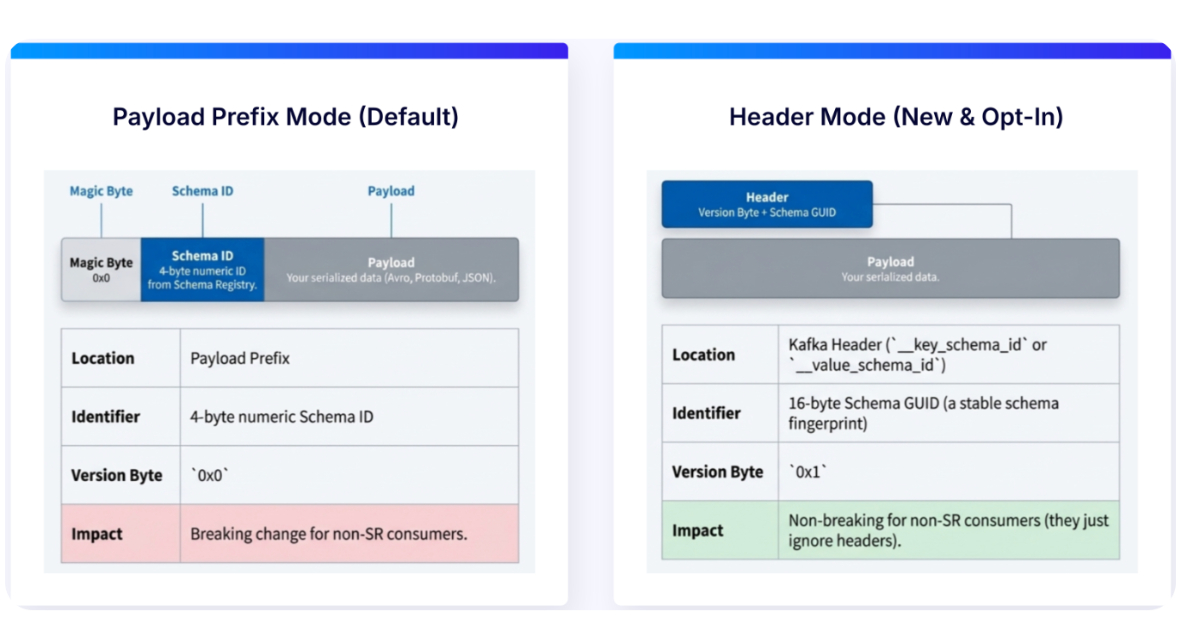
Previously, schema IDs were embedded directly inside the message payload, meaning every record carried a unique identifier for its schema alongside the actual data. With this update, Confluent moves those IDs into Kafka record headers, which are separate metadata fields attached to each message. This separation means that the schema ID is no longer part of the payload itself, but rather an external attribute of the record. The change is designed to work seamlessly with Confluent Schema Registry, allowing systems to look up schemas based on the header without parsing the payload first. This reduces overhead and makes it easier to evolve schemas without affecting downstream consumers in a disruptive way.
Why did Confluent decide to move schema IDs to headers?
The primary motivation was to simplify schema governance. When schema IDs reside in the payload, they create a tight coupling between the data and its metadata. Any change to how the ID is stored or interpreted can break message parsing. Moreover, in multi-format environments (Avro, JSON, Protobuf), each format handled IDs differently, leading to compatibility challenges. By placing IDs in headers, Confluent standardizes how schema references are stored across all serialization formats. This approach also makes it possible for tools like Schema Registry to enforce compatibility rules without needing to know the payload format. The result is a more flexible and scalable event-driven system where metadata and data evolve independently.
How does this affect serialization formats like Avro or Protobuf?
This change improves compatibility across different serialization formats. In the past, each format had its own way of embedding schema IDs, which meant that a consumer needed format-specific logic to extract and interpret the ID. By moving IDs to headers, Confluent creates a consistent mechanism regardless of whether you use Avro, JSON Schema, or Protobuf. For example, an Avro-serialized message might have had its ID in the first few bytes of the payload, while a JSON message might not have had any standard place for it. Now, all formats can store the schema ID in a standard header location. This uniformity simplifies the code in consumers and producers, reduces bugs, and makes it easier to switch between serialization formats without major rewrites.
What role does Schema Registry play in this new approach?
Schema Registry is central to this update. It already stores and manages schemas, and now it also handles the mapping between schema IDs in headers and the actual schema definitions. When a producer sends a message, it registers the schema with Schema Registry, gets back an ID, and places that ID in the record header. Consumers, upon receiving the message, extract the ID from the header, query Schema Registry for the corresponding schema, and then deserialize the payload accordingly. This decouples the schema look-up from the payload parsing, making the system more robust. Schema Registry can also enforce compatibility rules (backward, forward, full) based on the schema ID without needing to read the payload, allowing for automatic schema evolution checks before any data is written.
/presentations/game-vr-flat-screens/en/smallimage/thumbnail-1775637585504.jpg)
How does this change reduce coupling between data and metadata?
By moving the schema ID out of the payload and into a header, the data itself no longer contains metadata about its structure. This means that if you need to change how schemas are referenced (e.g., from integer IDs to strings), you can update the header handling without modifying the payload format. Similarly, the payload can be valid for multiple schema versions as long as the header points to the correct one. This separation of concerns allows the data pipeline to evolve more independently. For example, you could add a new field to your schema without having to ensure that all old messages still parse correctly; the header tells the consumer which schema version applies. This reduces the risk of breaking changes and makes it easier to maintain event-driven systems over time.
What are the benefits for developers and operations teams?
For developers, the new approach simplifies client code because they no longer need to handle schema ID extraction from varying payload positions. The header provides a uniform location, reducing boilerplate and potential errors. Operations teams benefit from easier schema governance: they can enforce compatibility policies at the broker level by inspecting headers, and schema migrations become safer because the schema ID is not hardcoded into the data. Additionally, this change supports better tooling for monitoring and debugging—since headers are visible at the Kafka protocol level, you can track schema usage without parsing every message. Overall, it lowers the complexity of managing schemas in large-scale event-driven architectures, leading to faster development cycles and more reliable data pipelines.
Is this compatibility breaking for existing deployments?
The update is designed to be backward compatible. Confluent has introduced this change as an opt-in feature, meaning existing producers and consumers that still embed schema IDs in payloads will continue to work without modification. However, to take advantage of the new benefits, clients need to be updated to support reading schema IDs from headers. During a transition period, both approaches can coexist. Confluent provides client libraries that can be configured to use the new header-based approach, and the Schema Registry supports both methods. Over time, as users migrate, the old payload-based method will likely be deprecated. For new deployments, it's recommended to use the header-based approach from the start to get the full benefits of simplified governance and improved compatibility.
Related Articles
- Unlocking Google Messages’ Latest Features: A Comprehensive Guide to May 2026 Updates
- Energizer's Child-Safe Batteries for AirTags: Your Questions Answered
- HASH Launches Free Simulation Platform to Tackle Complex Real-World Problems
- Your Complete Guide to Snagging the Motorola Razr Fold Before It's Gone
- Taming IoT Technical Debt from AI-Generated Code: A Practical Guide
- HarmonyOS Uncovered: A Deep Dive into Huawei's Open Source OS and Its Rapid Growth
- Growing Distrust: How Screen Time Fears Are Reshaping Education Technology Oversight
- Firefox 151: Enhanced Privacy, VPN Locations, and Critical Security Fixes