TurboQuant: Revolutionizing KV Cache Compression for LLMs
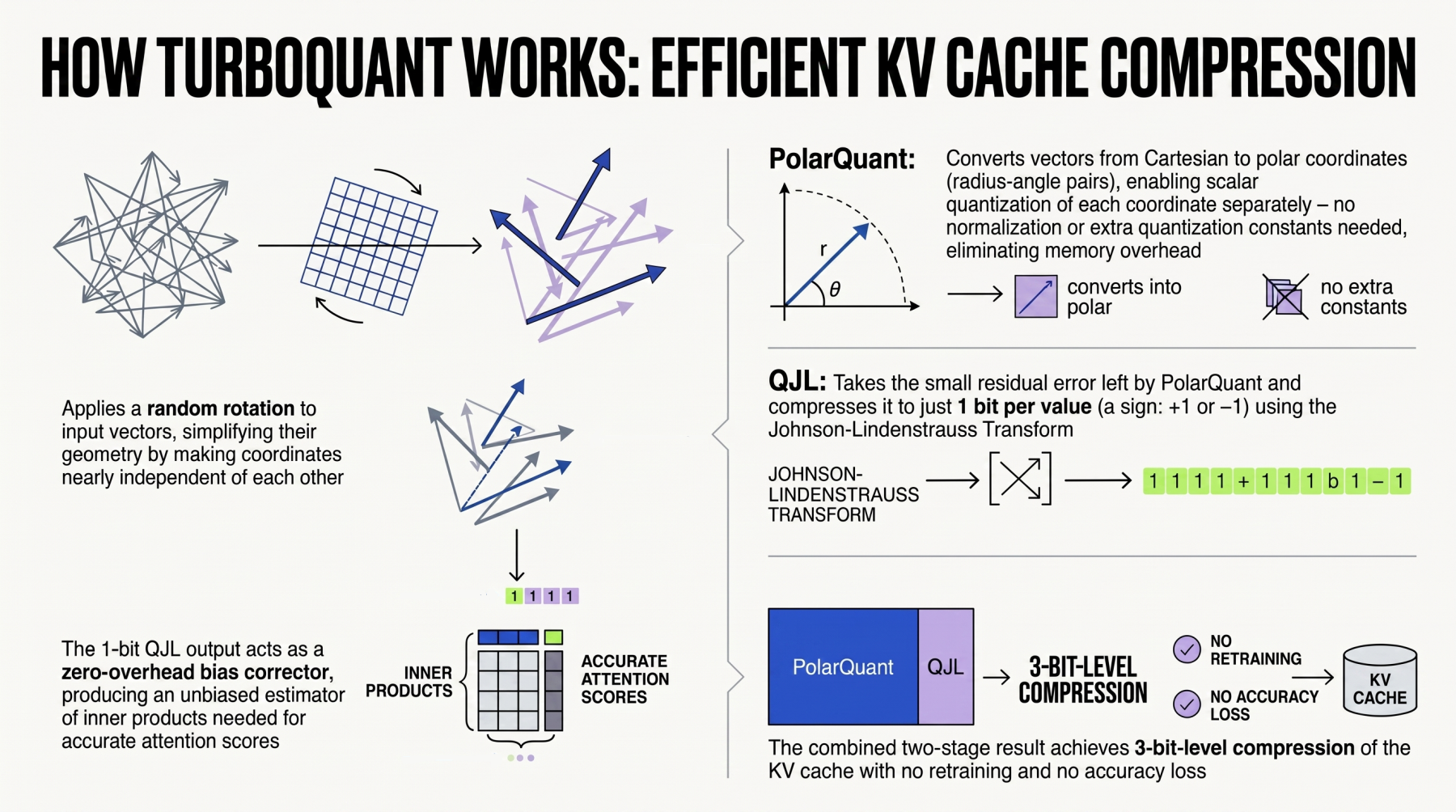
TurboQuant, developed by Google, is a cutting-edge algorithmic suite and library designed to enhance the performance of large language models (LLMs) and vector search engines through advanced quantization and compression techniques. It specifically targets the key-value (KV) cache, a critical bottleneck in deploying LLMs at scale. Below, we explore common questions about TurboQuant and its impact on AI systems.
What is TurboQuant and what problem does it solve?
TurboQuant is a novel toolbox from Google that applies advanced quantization and compression to large language models (LLMs) and vector search engines. It directly addresses the memory and speed bottlenecks associated with the key-value (KV) cache in transformer-based LLMs. As models grow larger, the KV cache—which stores intermediate attention computations—expands linearly with sequence length and batch size, often consuming gigabytes of high-bandwidth memory (HBM). TurboQuant reduces this memory footprint by compressing KV cache entries, allowing longer sequences, larger batches, and faster inference without sacrificing accuracy. This makes it indispensable for production RAG (Retrieval-Augmented Generation) systems and real-time applications.
Why is KV cache compression crucial for LLM deployment?
The KV cache is a major memory hog in autoregressive LLMs during inference. For each token generated, the model needs to store key and value vectors from all previous attention layers. With context windows reaching 100K+ tokens, the cache can occupy dozens of gigabytes of GPU memory, limiting batch size and throughput. Compressing this cache reduces memory pressure, enabling deployment on fewer GPUs, lowering cloud costs, and supporting longer contexts. TurboQuant uses quantization (e.g., 4-bit or 2-bit representations) and structural pruning to shrink the cache while maintaining model quality. Without such compression, scaling LLMs to large user bases becomes expensive and slow.
How does TurboQuant achieve effective KV compression?
TurboQuant employs a combination of techniques: uniform and non-uniform quantization, per-channel and per-token scaling, and adaptive compression based on attention patterns. It analyzes the distribution of key and value vectors to determine optimal bit-widths, using a lightweight calibration step that respects the model's original behavior. The suite implements fast CUDA kernels for on-the-fly compression and decompression, minimizing latency overhead. Importantly, it supports mixed-precision compression where certain layers or tokens retain higher fidelity based on their importance to output quality. This balances memory savings (up to 4× reduction) with negligible accuracy degradation, even for complex reasoning and long-context tasks.
What benefits does TurboQuant offer for RAG systems?
In RAG (Retrieval-Augmented Generation) systems, vector search engines retrieve relevant document chunks, which are then fed into an LLM along with the query. The LLM's KV cache now includes both the query and the retrieved context. If the context is long, the cache size skyrockets. TurboQuant compresses this cache, allowing the LLM to process more retrieved documents in a single pass without exceeding memory limits. This leads to higher recall, faster response times, and lower infrastructure costs. Additionally, TurboQuant optimizes the vector search engine itself by compressing embeddings, enabling larger index sizes and faster nearest-neighbor searches. The result is a more efficient and scalable RAG pipeline ideal for enterprise knowledge bases.
Is TurboQuant available as open-source or as a library?
Yes, TurboQuant has been released by Google as an open-source library, making it accessible to the research and engineering community. It integrates seamlessly with popular LLM frameworks like PyTorch and Hugging Face Transformers. The suite includes ready-to-use compression configurations for many common model families (e.g., Gemma, Llama, GPT). Users can apply it with minimal code changes, typically adding a few lines to wrap the model's forward pass. Detailed documentation and calibration scripts are provided, along with benchmarks showing memory savings and latency improvements. This openness encourages adoption and further development by the community.
How does TurboQuant compare to other KV cache compression methods?
TurboQuant distinguishes itself through algorithmic sophistication and practical engineering. Compared to naive quantization (e.g., simple 8-bit rounding), it achieves 2–4× better compression with similar perplexity. Techniques like SpAtten or H2O that prune cache entries may drop important context; TurboQuant's adaptive quantization avoids such irreversible loss. It also outperforms recent methods like KIVI and GEMM_QUANT by providing a holistic solution covering both LLM and vector search contexts. In benchmarks on Gemma-7B and Llama-13B, TurboQuant retains over 99% of the original model's accuracy on standard NLP tasks while reducing KV cache memory by 75%. Its library is also better optimized for modern GPU architectures like NVIDIA H100, yielding up to 30% faster end-to-end inference.
What future developments are expected for TurboQuant?
Given its strong foundation, TurboQuant will likely expand in several directions. Support for multimodal LLMs (e.g., vision-language models) is a natural next step, compressing cross-modal caches. Integration with speculative decoding and other inference acceleration techniques could yield further speed gains. Google may also extend TurboQuant to handle dynamic contexts where the cache needs continuous updates during interactive sessions. On the algorithmic side, we can expect more advanced quantization schemes like vector quantization or learned compression. The open-source community will contribute customizations for niche models. Ultimately, TurboQuant could become a standard component in LLM inference stacks, similar to how TensorRT-LLM is used today.
Related Articles
- Coursera and Udemy Merge to Form World’s Largest Skills Platform — Reaching 290M+ Learners
- The 19-Year-Old Crypto Key Failure: 10 Critical Lessons from Taiwan's High-Speed Rail Hack
- Markdown Mastery Now Non-Negotiable for GitHub Users, Experts Warn
- 10 Essential Markdown Tips for GitHub Newcomers
- Breaking: New Framework Reveals Design Teams Thrive When Manager and Lead Roles Overlap, Not Separate
- New Data Generation Methods Break AI Training Bottleneck with Minimal Examples
- How to Skill Up for the Future: A Step-by-Step Guide to Earning Microsoft Professional Certificates on Coursera
- How Tim Cook Engineered Apple's Trillion-Dollar Expansion: A Leadership Playbook