Nous Research’s Hermes Agent Surpasses 140K GitHub Stars, Revolutionizes Local AI with Self-Improving Skills on NVIDIA Hardware
In a breakthrough for agentic AI, Nous Research’s Hermes agent has become the most widely used AI agent globally on the OpenRouter platform, crossing 140,000 GitHub stars in under three months. The open-source framework is designed for reliability and continuous self-improvement, and is optimized to run on NVIDIA RTX PCs, RTX PRO workstations, and the DGX Spark — enabling always-on, local inference at maximum speed.
“We built Hermes to tackle the longstanding challenges of agent reliability and adaptability,” said a Nous Research spokesperson. “The community’s rapid adoption confirms that users want agents that learn and improve without constant debugging.”
Four Standout Capabilities Set Hermes Apart
Unlike other agents, Hermes writes and refines its own skills over time. It treats sub-agents as isolated, short-lived workers dedicated to subtasks, keeping context windows small and task organization tidy. Every skill, tool and plugin shipped with Hermes is curated and stress-tested by Nous Research, reducing the need for debugging even with 30-billion-parameter local models. Developer comparisons using identical models show stronger results in Hermes due to its active orchestration layer, not a thin wrapper.
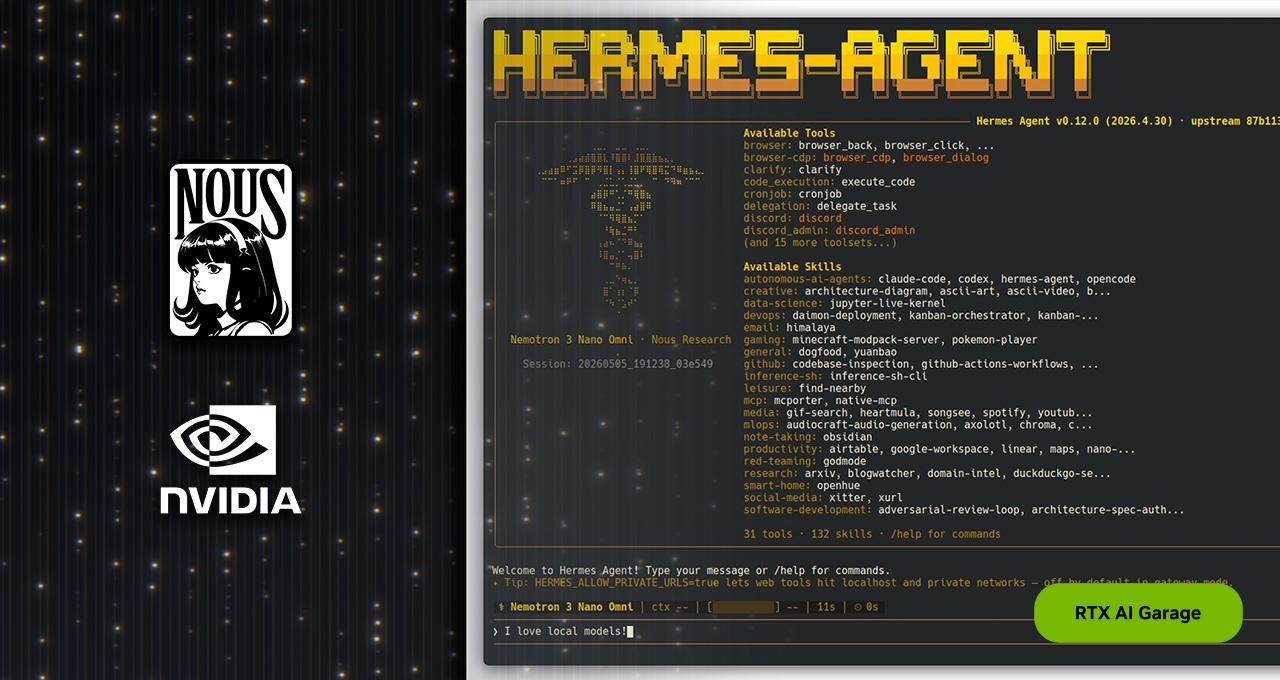
“The framework itself acts as a persistent, on-device layer rather than a task-by-task executor,” added the spokesperson. “That’s why users see the same model perform better inside Hermes.”
Background: The Rise of Agentic AI
Agentic AI is transforming how users get work done, following the success of earlier frameworks like OpenClaw. The open-source community is increasingly adopting agent-based approaches, and Hermes has emerged as a leader. It is provider- and model-agnostic by design, making it compatible with a wide range of large language models (LLMs).
Building on the success of OpenClaw, Hermes achieved 140,000 GitHub stars in under three months and is now the most used agent on OpenRouter as of last week. Its design emphasizes reliability and self-improvement — two qualities historically hard to achieve with agents.
Ideal Hardware: NVIDIA RTX PCs and DGX Spark
Both the Hermes agent and the underlying LLM are built to run locally, meaning hardware quality directly determines user experience. NVIDIA RTX GPUs are purpose-built for these workloads, offering dedicated acceleration for agentic AI. The DGX Spark, a compact AI supercomputer from NVIDIA, provides additional compute for around-the-clock operation.

“Running Hermes on NVIDIA hardware unlocks its full potential for always-on, high-speed inference,” said an NVIDIA AI expert. “It’s a natural fit for users who want to keep their data local while harnessing cutting-edge agent capabilities.”
Qwen 3.6 Models Supercharge Local Agents
Alibaba’s new Qwen 3.6 series of open-weight LLMs — specifically the 27B and 35B parameter models — are ideal for powering local agents like Hermes. These models outperform their previous-generation 120B and 400B parameter counterparts while requiring far less memory. The 35B model runs on roughly 20GB of memory, compared to over 70GB for the older 120B model.
The Qwen 3.6 27B model is a dense model with more active parameters, matching the accuracy of 400-billion-parameter models. Combined with NVIDIA RTX or DGX Spark hardware, these models accelerate agentic AI without compromising performance.
What This Means
The combination of Hermes, Qwen 3.6 models, and NVIDIA hardware democratizes access to powerful, self-improving AI agents. Users no longer need cloud services to run advanced agentic workloads; they can do so locally on consumer-grade PCs and workstations.
This shift has profound implications for privacy, latency, and cost. Businesses and individuals can deploy persistent, on-device agents that adapt over time without sending sensitive data to external servers. As the ecosystem matures, we can expect further competition among frameworks and hardware vendors to optimize for local agentic AI.
“This is just the beginning of a new era in AI where agents live on your machine and get better every day,” concluded the Nous Research spokesperson. “Hermes shows that open-source collaboration can deliver enterprise-grade reliability and intelligence to everyone.”
Related Articles
- How to Escape the WebRTC Forking Trap: A Step-by-Step Guide to Continuous Upstream Integration
- Ploopy Bean: A Unique Open-Source Pointing Stick Mouse Hits the Market
- The Transparency Paradox: How States Are Restricting Access to License Plate Reader Data
- Python 3.13.10 Released: A Maintenance Update with 300+ Fixes
- Meta Breaks Free from WebRTC 'Forking Trap' with Dual-Stack Architecture for 50+ Use Cases
- GitHub's Journey to Reliability: Addressing Rapid Growth and Incidents
- A Step-by-Step Guide to Running Hardware-Assisted Arm Virtual Machines on s390 Hosts
- Building a Continuous Accessibility Feedback System with AI: A Step-by-Step Guide