Mastering Real-Time Data Streams with Python's deque
When processing streaming data or implementing sliding window algorithms, many Python developers default to using lists. However, lists have a hidden cost: shifting elements during append or pop at the front. The collections.deque (double-ended queue) offers a lightweight, thread-safe alternative that excels in real-time scenarios. Below, we answer key questions about using deque for high-performance sliding windows and efficient data streams.
1. What exactly is a deque and how does it differ from a list?
A deque (pronounced “deck”) is a data structure from the collections module optimized for fast appends and pops from both ends. Unlike a list, which stores elements in contiguous memory, a deque uses a doubly-linked list of fixed-size blocks. This design gives it O(1) time complexity for appendleft and popleft, whereas a list requires O(n) because every element must be shifted. For example, removing the first element from a list of 10,000 items would shift 9,999 elements; a deque handles it instantly.

2. Why shouldn’t I use a list for sliding windows?
Sliding windows typically involve adding new data at one end and removing old data from the other. With a list, using pop(0) or insert(0, item) triggers an O(n) shift operation. Over thousands of windows, this becomes a performance bottleneck, especially in real-time applications like stock price tracking or sensor data processing. A deque eliminates this overhead because both popleft and append are constant-time operations. In benchmarks, deque can be 10–100x faster than list for large sliding windows.
3. Is deque thread-safe? Can I use it for producer-consumer queues?
Yes, deque is thread-safe for individual append and pop operations because of its C implementation and the GIL (Global Interpreter Lock). However, it is not designed for blocking behavior—if you need a queue that waits when empty, use queue.Queue instead. For simple, non-blocking data exchange between threads (e.g., logging or event streaming), deque works reliably. To make it more robust, you can wrap it with a threading.Lock if you perform compound operations (like checking length then popping).
4. How can I use deque for real‑time sliding windows efficiently?
Here’s a concrete pattern: define a fixed window size, then for each new data point, append it and if the window exceeds the size, popleft the oldest. This maintains exactly n elements. For example, tracking the moving average of a stock price:
from collections import deque

class MovingAverage:
    def __init__(self, size):
        self.window = deque(maxlen=size)
        self.sum = 0.0

    def add(self, val):
        if len(self.window) == self.window.maxlen:
            self.sum -= self.window.popleft()
        self.window.append(val)
        self.sum += val
        return self.sum / len(self.window)
The maxlen parameter automatically discards old items when full, making the code clean and efficient.
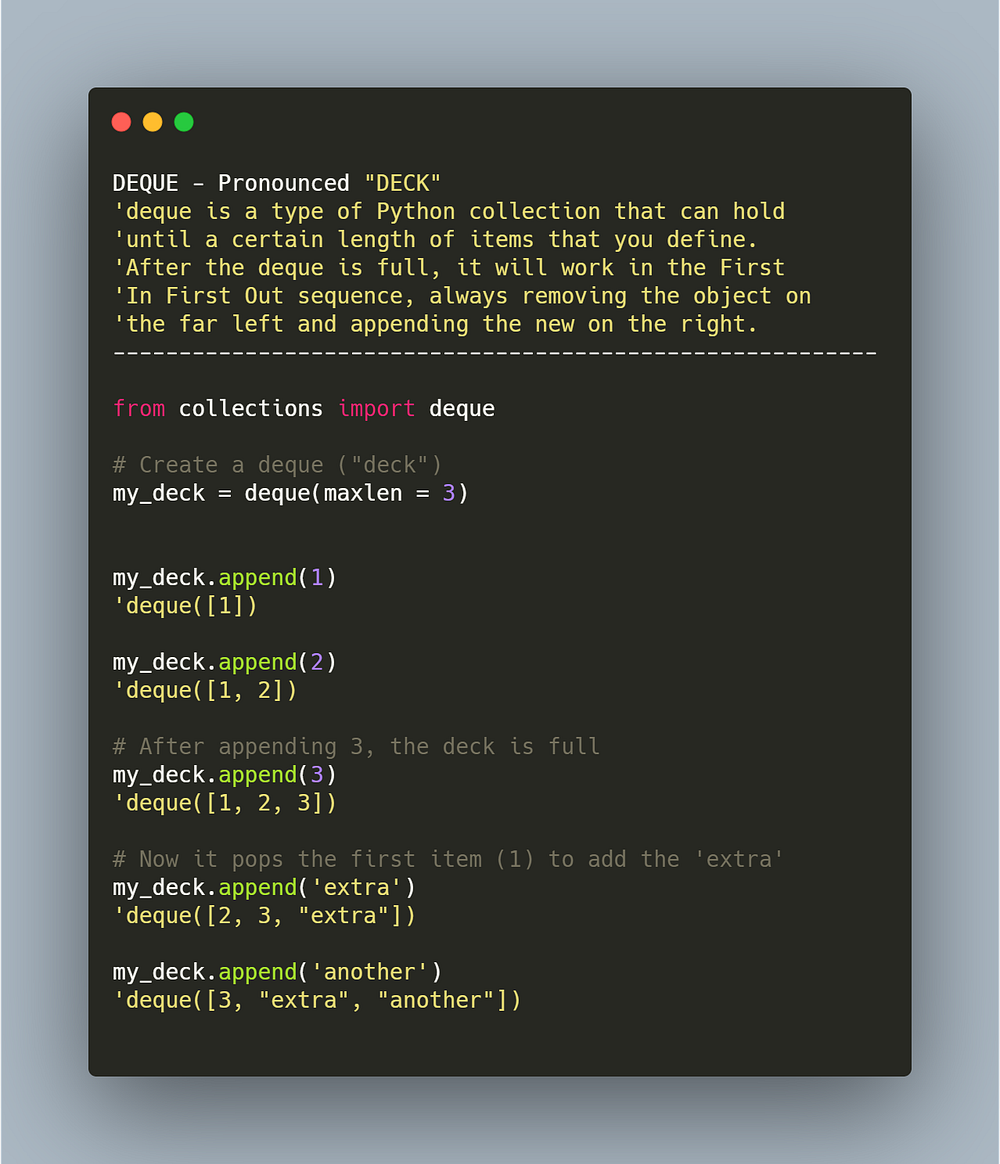
5. What does the performance difference look like in practice?
Consider a sliding window of 10,000 elements processing 100,000 updates. Using a list with pop(0) and append would take several seconds due to repeated memory shifts. A deque with popleft() and append() completes the same workload in milliseconds. In a real-time system, that difference can mean the difference between keeping up with incoming data and falling behind. For data streams with high velocity (e.g., IoT sensors or financial tick data), deque is the clear winner.
6. Are there cases where a list is still better than a deque?
Yes. Use a list when you need random access by index frequently (e.g., my_list[500]). Deque supports indexing but it is O(n) from either end, not O(1). For operations that mostly involve appending/popping only at the right end (like a stack), a list is fine. Also, if you need slicing (my_list[10:20]), lists are superior. Deque shines in FIFO-style or double-ended access where performance at both ends matters.
7. Quick recap: when should I reach for deque?
- Implementing a sliding window of fixed or dynamic size.
- Building a thread-safe non-blocking queue for streaming.
- Managing an undo/redo buffer that needs fast
appendleft. - Processing real-time data where every millisecond counts.
By replacing list-based shift operations with deque, you get cleaner code and significantly better performance.
Related Articles
- Mastering Python's Deque for High-Performance Sliding Windows
- Exclusive: Meta’s AI Agent Swarm Successfully Maps 4,100-File Pipeline, Slashes Errors by 40%
- Exploring TaskTrove: A Q&A Guide to Streaming, Parsing, and Analyzing Dataset Tasks
- Ensuring Consistency and Reliability in Scoring Models: A Python Guide to Monotonicity and Stability Checks
- From 61 Seconds to 0.2: How Polars Revolutionized a Real Data Workflow
- Catch PyTorch NaNs at the Source: Build a 3ms Layer-Level Detector
- A Practical Guide to Selecting the Right Regularizer: Ridge, Lasso, or ElasticNet (Backed by 134,400 Simulations)
- Beyond RAG: How Pinecone's Nexus Knowledge Engine Redefines AI Agent Data Access