How to Implement Off-Policy Reinforcement Learning Without Temporal Difference Learning
Introduction
Reinforcement Learning (RL) often relies on Temporal Difference (TD) learning to estimate value functions. However, TD methods struggle with long-horizon tasks because errors accumulate through bootstrapping. This guide introduces a divide-and-conquer paradigm that replaces TD learning with Monte Carlo (MC) returns, enabling scalable off-policy RL. You will learn step-by-step how to design an algorithm that avoids the pitfalls of TD while handling complex, long-horizon environments.
What You Need
- Familiarity with basic RL concepts (policy, value function, Q-learning).
- Understanding of on-policy vs off-policy learning.
- A programming environment (e.g., Python with NumPy, PyTorch).
- A benchmark task with long episodes (e.g., robotics simulation, dialogue system).
- Optional: existing RL framework (e.g., Stable-Baselines3) for comparison.
Step-by-Step Guide
Step 1: Understand the Off-Policy Setting
Before coding, clarify the problem. Off-policy RL allows you to reuse any past experience—old trajectories, human demonstrations, or internet data—to train the policy. This contrasts with on-policy methods (like PPO) that only use fresh data. Off-policy is crucial when data collection is expensive (e.g., healthcare, robotics).
Step 2: Recognize Limitations of TD Learning
Standard Q-learning uses the Bellman equation: Q(s,a) ← r + γ maxa' Q(s',a'). Error in Q(s',a') propagates to Q(s,a) through bootstrapping. Over long horizons, these errors accumulate, making TD brittle. One common fix is n-step TD, which mixes MC returns for the first n steps: Q(st,at) ← Σ γi rt+i + γn maxa' Q(st+n, a'). However, this still uses bootstrapping for the tail. For a cleaner solution, consider removing TD entirely.
Step 3: Adopt the Divide-and-Conquer Paradigm
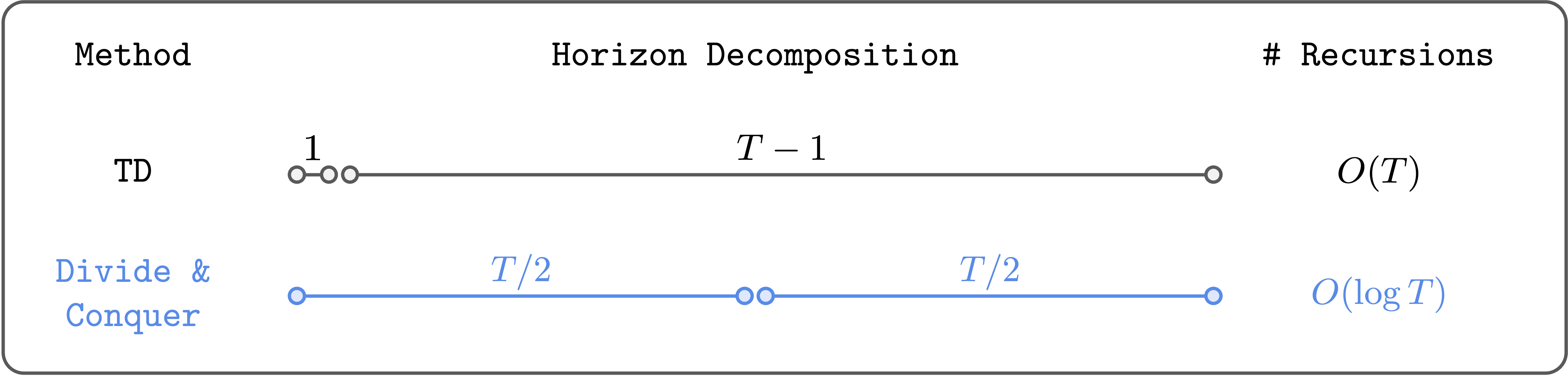
The core idea: break the long-horizon task into smaller sub-horizons. Instead of bootstrapping from a learned value, use pure Monte Carlo returns from the dataset for each sub-horizon. This avoids error accumulation because there is no recursive Bellman update. The algorithm is:
- Decompose the episode into chunks of length n (e.g., 10, 100 steps).
- For each chunk, compute the discounted cumulative reward from the dataset (no bootstrapping).
- Use these chunk returns as targets for the value function or policy update.
Step 4: Design the Value Function Training
You now have a dataset of (state, action, chunk-return) pairs. Train a neural network to predict the expected return from a given state-action pair. Use standard supervised learning (e.g., mean squared error). This eliminates the TD error propagation entirely.

Step 5: Choose Chunk Size Carefully
The chunk size n is a key hyperparameter. Smaller n reduces variance but may lose long-term credit assignment. Larger n captures longer dependencies but requires more data. Experiment with n from 5% to 50% of the average episode length.
Step 6: Integrate Policy Improvement
This divide-and-conquer approach fits naturally with off-policy policy improvement. For example, you can use the learned value function to select actions via Q-learning (but with MC targets), or directly update the policy via gradient-based methods (e.g., deterministic policy gradient). The key is that the value function itself is not updated with TD.
Step 7: Test on Long-Horizon Tasks
Evaluate your implementation on tasks with episode lengths >1000 steps. Compare with standard DQN (TD) and n-step TD. You should observe more stable learning and better final performance, especially in tasks with sparse rewards or long time delays.
Tips for Success
- Start with pure MC: For very long episodes, consider using n = infinity (i.e., use the full return). This avoids any bootstrapping but may increase variance.
- Hybrid approaches: You can mix divide-and-conquer with TD by using MC targets for early episodes and gradually introducing bootstrapping for later episodes.
- Data efficiency: Off-policy divide-and-conquer can leverage diverse data sources. Ensure your replay buffer contains varied trajectories to reduce overfitting.
- Watch the computational cost: Computing chunk returns requires storing full trajectories. Implement efficient rolling-window computations in your pipeline.
- Benchmark: Use standard long-horizon benchmarks like HalfCheetah or Ant for locomotion, or dialogue systems with turn-based rewards.
By following these steps, you can build an RL algorithm that scales to long horizons without the error accumulation of TD learning. The divide-and-conquer paradigm offers a principled way to achieve stable off-policy learning.
Related Articles
- The Third Path: Transforming Workplace Restlessness into Fulfillment
- How to Add Temporal Awareness to Your RAG System in Production
- Building Production-Grade ML Pipelines with ZenML: A Comprehensive Q&A Guide
- Mastering the Model Context Protocol: A Comprehensive Guide to Building AI-Powered Applications
- Mastering Modern Power System Studies: Modeling and Simulation Q&A
- 8 Keys to Shared Design Leadership: A Holistic Framework for Design Managers and Lead Designers
- Textured PEI Plates Emerge as Preferred 3D Printing Build Surface, Experts Confirm Shift in User Preferences
- Vocal Fry: Debunking the Gender Stereotype – Men Use Creaky Voice More Often